Santa Moose Tri-Shutter Card: A Maker’s Review
As a designer who constantly bridges the gap between digital files and tangible, handmade products, I approach every new asset with a critical eye. When evaluating the Santa Moose Tri-Shutter Card, my first thought wasn't just about the festive charm; it was about structural integrity and versatility. This isn't merely a flat graphic; it is a 3D SVG cutting template designed to create an interactive paper experience. For embroidery designers, Etsy sellers, and craft business owners, this distinction matters immensely. We aren't just looking for a pretty picture; we are looking for a design that translates into a high-value finished product, whether that remains a paper card or evolves into a mixed-media textile project.
First Impressions and Structural Versatility
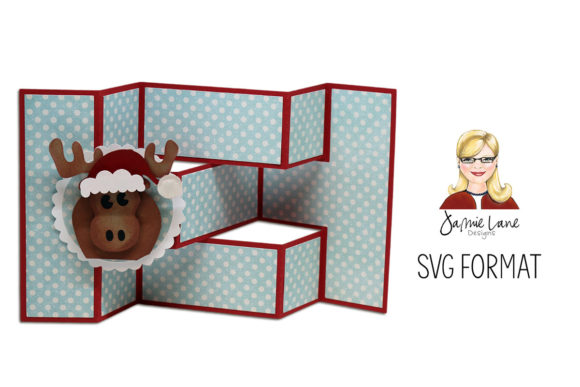
The immediate appeal of the Santa Moose Tri-Shutter Card lies in its mechanical layout. Measuring approximately 3-3/4 x 6 inches when assembled, the tri-shutter mechanism offers three distinct panels rather than a single static face. From a design perspective, this creates natural segmentation. The included score lines, mats, and paper embellishments suggest a polished, professional assembly right out of the box. However, as someone who frequently adapts digital assets for custom apparel and holiday embroidery, I see something else: a built-in storyboard.
The segmented nature of this Christmas design makes it uniquely suited for adaptation. Unlike complex, dense illustrations that lose their soul when resized or separated, the Santa Moose layout invites modification. The visual personality is whimsical yet structured, striking a balance that appeals to both boutique shoppers and recipients of personalized gifts. It feels substantial, which is exactly the mood you want to convey when selling premium handmade items during the holiday rush.
Real-World Application: From Paper to Textile
To truly test the viability of this asset, I considered a recent client request for a series of holiday gift tags and coordinating tote bag designs. Often, creators struggle to make a card design work on fabric because the scale is wrong. Here, the Santa Moose Tri-Shutter Card excels because of its modular components.
In a real-life scenario, I utilized the individual shutter panels as separate applique design elements for a set of canvas tote bags. Instead of forcing the entire card onto a bag, I isolated the moose motif for the center and used the decorative mats as pocket accents. This approach transformed a paper template into a cohesive collection of small shop products. For sweatshirt embroidery, the clean lines of the SVG serve as an excellent guide for digitizing. The separation of layers means you can assign different stitch types—perhaps a satin stitch for the borders and a fill stitch for the moose—without fighting against unnecessary detail.
For those running an Etsy shop or preparing for craft fairs, this adaptability increases your ROI. You aren't just selling a card; you are leveraging the geometry of the design to create embroidered patches, nursery decor, or even tea towel sets. The tri-fold concept also translates beautifully to digital product previews and printable mockups, allowing customers to visualize the depth of the final piece before purchasing.
Navigating Fabric Limitations and Stitch Density
While the Santa Moose Tri-Shutter Card is versatile, it requires thoughtful execution when moving from paper to needle. Not every fabric welcomes this level of geometric precision. If you are adapting this for baby embroidery or lightweight garments, caution is necessary. The original template includes score lines intended for folding paper; in embroidery, these must be reimagined as running stitches or removed entirely to prevent puckering on stretchy fabrics.
I advise testing this design on scrap fabric before committing to a commercial run. On textured fabrics like linen or terry cloth, the intricate mats shown in the template may get lost. In these cases, simplifying the design assets is key. Conversely, on dark fabrics, ensure your thread colors provide enough contrast to define the shutter boundaries. Without that definition, the 3D effect vanishes, and the design looks flat.
Hoop size is another practical consideration. At roughly 3-3/4 x 6 inches, the full assembly pushes the limits of standard 4x4 hoops. If you are working with smaller machines, you will need to resize or split the design. Always verify the dimensions within your specific embroidery file software. Resizing can alter stitch density, potentially making the mats too dense for delicate fabrics or too sparse for sturdy canvas. Stabilizer choice becomes non-negotiable here; a tear-away might suffice for paper-like cardstock, but a cut-away is essential if you are adapting this silhouette for custom apparel to maintain the crisp edges of the shutters.
Elevating Perceived Value and Brand Consistency
In the competitive landscape of holiday embroidery and paper crafting, presentation dictates price. The Santa Moose Tri-Shutter Card offers a distinct advantage: interactivity. When a customer opens a tri-shutter card, they engage with the product physically. This tactile experience builds trust and perceived value far better than a standard flat card.
For creative entrepreneurs, maintaining brand consistency across mediums is challenging. Using this unified design language across your paper goods and textile products creates a recognizable aesthetic. Imagine offering a matching set: the physical tri-shutter card alongside an embroidered patch featuring the same moose motif. This cross-merchandising strategy encourages higher cart values. Furthermore, the professional finish of the included mats and embellishments ensures that even if you are a hobbyist maker, your output looks boutique-ready. Clean lines and intentional layering signal professionalism to buyers browsing Etsy listings or visiting local markets.
Critical Designer Notes for Success
Before adding this to your production queue, keep these practical checkpoints in mind to ensure your finished product meets professional standards:
- Verify Licensing: Always confirm whether the license permits commercial use for both physical cards and adapted embroidery projects. Digital embroidery file rights often differ from paper cutting rights.
- Test Contrast: Create black and white mockups to ensure the design reads clearly without color reliance. This is vital for accessibility and for customers viewing listings on mobile devices.
- Check Small Details: Inspect the smallest elements of the mats and embellishments. If they are thinner than 2mm, they may not stitch out cleanly as satin stitches and might require adjustment to fill stitches or running stitch outlines.
- Stabilizer Strategy: Match your stabilizer to the end use. Paper projects need scoring, while fabric projects need support. Do not assume one method works for both.
- Mockup Accuracy: When creating printable mockups for digital sales, represent the 3D aspect accurately. Flat photos fail to sell the tri-shutter mechanism.
- Washability: If adapting for kitchen towels or baby items, remember that paper-centric details may not withstand frequent washing. Simplify the design for functional textiles.
The Santa Moose Tri-Shutter Card is more than a seasonal novelty; it is a robust foundation for mixed-media creativity. By respecting its structural origins while intelligently adapting it for textile applications, makers can produce holiday goods that stand out for their craftsmanship and charm. Whether you are stitching a sweatshirt or assembling a luxury greeting card, let the design's inherent modularity guide your process toward a polished, profitable result.